
Views: 0 Author: Site Editor Publish Time: 2026-07-11 Origin: Site


Seal failure in closed and pressurized vessels presents immediate operational hazards. Fugitive emissions, toxic batch contamination, and catastrophic pressure loss halt production and endanger plant personnel. Sealing a top entry mixer requires a completely different engineering approach compared to sealing a standard centrifugal pump. Mixers utilize long overhung shafts that experience severe radial deflection during operation. Furthermore, these seals typically operate high up in the vapor space of the tank rather than being submerged in the liquid media.
Plant engineers must apply a systematic evaluation framework to select the correct sealing technology. You have to balance pressure ratings, vessel construction materials, media volatility, and maintenance downtime. A standard steel tank behaves differently than a glass-lined reactor under load. Understanding these mechanical variables allows you to specify a seal that maintains vessel integrity, prevents hazardous leaks, and optimizes long-term operational efficiency without unnecessary maintenance interventions.
Mixer Dynamics Dictate Seal Choice: Shaft runout and deflection in top entry applications require seals specifically engineered to handle radial movement, unlike standard pump seals.
Pressure and Volatility Drive the Baseline: Lip seals and packing are sufficient for low-pressure, non-hazardous applications, while volatile, corrosive, or high-pressure environments mandate single or double mechanical seals.
Vapor Space Realities: Because top entry seals often sit above the liquid line, dry-running contacting seals or specialized seal support systems (barrier fluids/gases) are frequently required.
Vessel Type Constraints: Sealing a standard steel tank differs significantly from sealing a glass-lined reactor, which demands specialized flange designs, specific dimensional sizing (typically 40 mm to 220 mm), and strict runout limits.
Maintenance Downtime is a Primary Cost Driver: Fully split cartridge mechanical seals significantly reduce maintenance expenses by eliminating the need to dismantle the heavy mixer drive, gearbox, and shaft during replacement.
A successful seal installation in a closed tank means achieving zero hazardous leakage, maintaining vessel pressure, and ensuring an acceptable wear life. You must address the specific mechanical and environmental conditions present at the top of the vessel. The physics of mixing dictate that the shaft will move, and the seal must accommodate this movement without failing.
Agitators utilize long overhung shafts to reach deep into the tank geometry. As fluid viscosities change during a batch reaction, fluid levels drop during pump-out, or mixing forces shift due to baffling, the shaft experiences significant radial movement. This wobble can quickly destroy rigid pump-style seals designed for short, highly supported shafts. Mixer seals must be engineered with larger internal clearances and flexible mounting arrangements to accommodate this runout without losing face contact or damaging elastomeric components. We measure this runout using dial indicators during installation to ensure it falls within the seal manufacturer's specified tolerances.
Pump seals are constantly submerged and cooled by the pumped fluid. Agitator seals usually operate in the gas or vapor space above the liquid line. They lack the natural cooling and lubrication provided by the liquid media. This thermal challenge requires specialized face materials or external support systems to prevent overheating. When faces run dry without proper material pairing, heat builds up rapidly, leading to thermal cracking, elastomer degradation, and immediate loss of containment.
Batch processing involves dynamic pressure conditions. Tanks alternate between pressurized states to hold nitrogen blankets or promote chemical reactions, and full vacuum conditions during filling or degassing. The seal must withstand these extreme pressure cycles without blowing out or drawing atmospheric contaminants into the vessel. Reversing pressure differentials can unseat mechanical seal faces if the seal is not specifically designed for dual-directional pressure containment.
Measure shaft runout at the seal location before specifying the seal type.
Calculate the maximum pressure and maximum vacuum the vessel will experience.
Determine the exact temperature of the vapor space, not just the liquid media.
Identify any abrasive particulates that might become airborne in the vapor space.
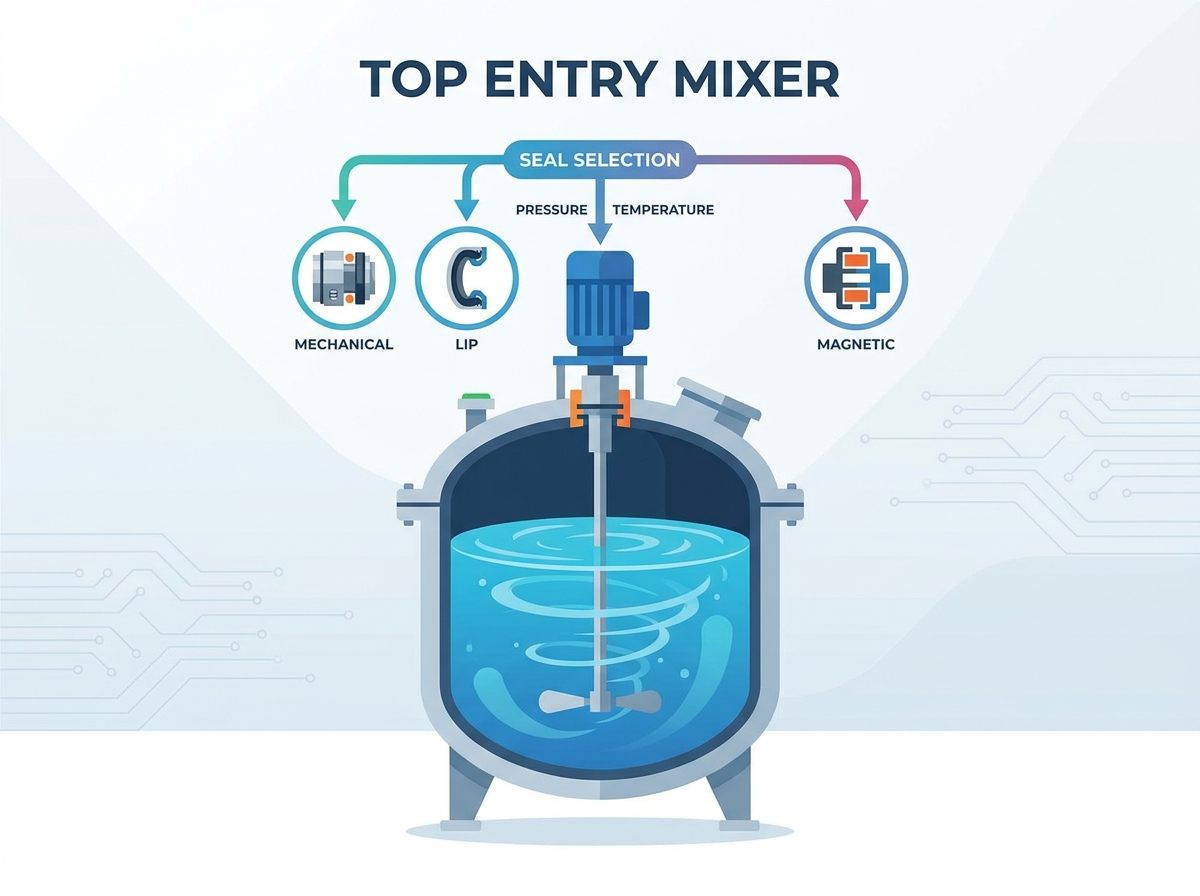
Selecting the correct approach involves moving from basic containment methods to advanced mechanical barriers. You match the seal technology to the severity of the application.
Lip seals provide basic dust and vapor control using elastomeric elements. Materials like Viton (FKM) and Teflon (Rulon) offer low-friction, chemically resistant performance. They are strictly limited to low-pressure or atmospheric closed tanks. You cannot use them for containing hazardous emissions or high pressures because the flexible lip will simply blow back and release the tank contents.
Packing seals offer a traditional method using braided materials compressed around the shaft. They require a small amount of acceptable leakage to lubricate the packing material. Operators must frequently adjust the gland follower to maintain the correct compression. Over time, the packing will wear a groove into the shaft or shaft sleeve, requiring expensive metal replacement. They are not suitable for strict emission control or high-vacuum applications.
Single mechanical seals provide moderate pressure containment for non-hazardous liquids and vapors. They are applied in closed tanks where minor vapor emissions are environmentally acceptable, but liquid leakage is strictly prohibited. They offer a significant upgrade over packing in terms of reliability and cleanliness. The faces are typically lubricated by the tank vapors, requiring careful material selection like carbon against silicon carbide.
Double mechanical seals deliver high-pressure, zero-emission containment by utilizing a pressurized barrier fluid or barrier gas between two sets of seal faces. This arrangement is mandatory for processing toxic, flammable, or highly volatile media. The barrier fluid is maintained at a pressure higher than the tank pressure, ensuring that if a leak occurs, the barrier fluid enters the tank rather than the hazardous media escaping into the atmosphere.
These seals run without liquid lubrication in the vapor space using self-lubricating face materials. They are heavily utilized in pharmaceutical, food and beverage, or specialty chemical applications where any barrier fluid contamination of the batch is completely unacceptable. They handle moderate pressures and eliminate the need for complex liquid barrier support systems.
Seal Type |
Pressure Limit |
Leakage Rate |
Maintenance Level |
Best Application |
|---|---|---|---|---|
Lip Seal |
Atmospheric |
High Vapor |
Low |
Dust control, non-hazardous |
Packing |
Low |
Moderate Liquid/Vapor |
High |
Water treatment, slurries |
Single Mechanical |
Moderate |
Low Vapor |
Low |
Standard chemicals |
Double Mechanical |
High / Vacuum |
Zero Emission |
Moderate (Support System) |
Toxic, flammable, high pressure |
Dry-Running |
Moderate / Vacuum |
Zero Emission |
Low |
Pharma, food, zero contamination |
To specify the right seal, evaluate the physical and chemical realities of your mixing process. You must look at the entire system, not just the rotating shaft.
Map the seal types to your specific pressure and temperature ranges. High-pressure applications quickly narrow the field to dual-pressurized mechanical seals. Lip seals and single seals fail under intense vessel pressure. Temperature affects the elastomers and the face materials. High temperatures in the vapor space require specialized cooling jackets around the seal housing or high-temperature perfluoroelastomers.
The corrosiveness of the tank media dictates the selection of O-rings and secondary sealing elements. You must match the elastomer to the specific chemical makeup of the batch.
Viton (FKM): Good for general purpose, oils, and moderate chemicals.
EPDM: Excellent for hot water, steam, and mild caustics.
PTFE (Teflon): Universal chemical resistance but lacks elasticity.
Kalrez (FFKM): Required for aggressive solvents and extreme temperatures.
Steel vessels allow for rigid mounting, standard ANSI or DIN flanges, and a higher tolerance for shaft vibrations. Glass-lined vessels require specialized seal designs to protect the delicate glass lining. The seal must accommodate specific glass-lined nozzle designs and adhere to strict runout constraints to avoid cracking the glass. You cannot weld or modify a glass-lined nozzle in the field, so the seal flange must fit perfectly from the factory.
Standard shaft sizing ranges typically fall between 40 mm and 220 mm. The seal housing must perfectly match the tank's nozzle configuration and mounting plate layout. We verify the bolt circle diameter, the nozzle bore, and the distance to the first obstruction inside the tank before ordering a seal.
For sanitary applications, the seal design must meet FDA, USP Class VI, and EHEDG compliance standards. The geometry must accommodate Clean-In-Place (CIP) and Sterilize-In-Place (SIP) protocols. You cannot have product-trapping dead legs where bacteria can grow. Sanitary seals often feature polished surfaces and open architectures to allow cleaning fluids to flush away all batch residue.
The initial purchase price of a seal is only a fraction of its true cost. Maintenance labor and equipment downtime play a massive role in the overall value of the installation.
Fully split cartridge mechanical seals address a major pain point of top entry mixer maintenance. They allow seal face and elastomer replacement directly on the shaft without requiring the removal of the heavy motor, gearbox, or shaft coupling. You unbolt the two halves of the seal, remove the worn components, and install the new split faces around the shaft. This drastically reduces maintenance labor from days to hours and keeps the equipment online.
Advanced mechanical seals carry a higher initial capital expenditure. They offset this by eliminating the labor and lost production costs associated with constantly replacing or adjusting cheaper packing seals. When a reactor goes down for a seal change, the lost batch time often costs more than the seal itself. Investing in a reliable cartridge seal pays for itself during the first avoided maintenance cycle.
Double mechanical seals introduce hidden complexities. They require the specification, installation, and maintenance of barrier fluid reservoirs, known as API Plans, or gas control panels. Proper management of these support systems is mandatory. If the barrier fluid pressure drops below the tank pressure, the hazardous media will breach the seal faces, causing catastrophic failure. Operators must monitor fluid levels, pressures, and temperatures daily.
Selecting the correct seal requires a strict calculation of tank pressure, vessel material, media hazard level, and allowable maintenance downtime. Packing and lip seals work for low-risk, atmospheric applications. Dry-running or single mechanical seals suit standard chemical processing in closed tanks. Double mechanical or split cartridge seals are mandatory for high-pressure, hazardous, glass-lined, or high-downtime applications.
Audit your current tank pressures, maximum vacuum levels, and operating temperatures.
Measure your vessel nozzle dimensions, ensuring they fall within the standard 40 mm to 220 mm range.
Record the shaft radial runout using a dial indicator to verify it meets seal manufacturer tolerances.
Consult with a mixing engineer to specify the exact seal arrangement and required API support system.
A: No. Mixers have long overhung shafts that experience significant radial runout and deflection. Standard pump seals are designed for short, rigid shafts and will fail prematurely if subjected to the wobble of a mixer shaft.
A: Lip seals are generally limited to very low pressures, often just a few PSI above atmospheric. They are unsuited for pressurized vessels because higher pressures will blow the elastomeric lip away from the shaft, causing immediate leakage.
A: These seals are located at the top of the tank in the vapor space, above the liquid line. They do not receive the natural cooling and lubrication that submerged seals get, so they must be engineered to run dry without overheating.
A: A split cartridge seal is manufactured in two halves, allowing it to be installed or rebuilt directly on the shaft. This bypasses the need to remove the heavy gearbox, motor, and shaft coupling, saving massive amounts of maintenance downtime.
A: In double mechanical seals, the barrier fluid is kept at a higher pressure than the tank pressure, ensuring any minor leakage goes into the tank rather than out. If contamination is unacceptable, dry-running gas seals are used as an alternative.
A: A stuffing box uses compressed braided packing that requires intentional leakage for lubrication and needs frequent adjustment. A mechanical seal uses precision-lapped faces to provide near-zero leakage and requires much less routine maintenance.
A: Glass-lined vessels require special flange protection to prevent cracking the glass, adhere to specific DIN/ANSI standards, and often utilize dry-running capabilities to prevent barrier fluid from contaminating highly sensitive batches.