- All
- Product Name
- Product Keyword
- Product Model
- Product Summary
- Product Description
- Multi Field Search
Please Choose Your Language
Views: 0 Author: Site Editor Publish Time: 2026-07-30 Origin: Site
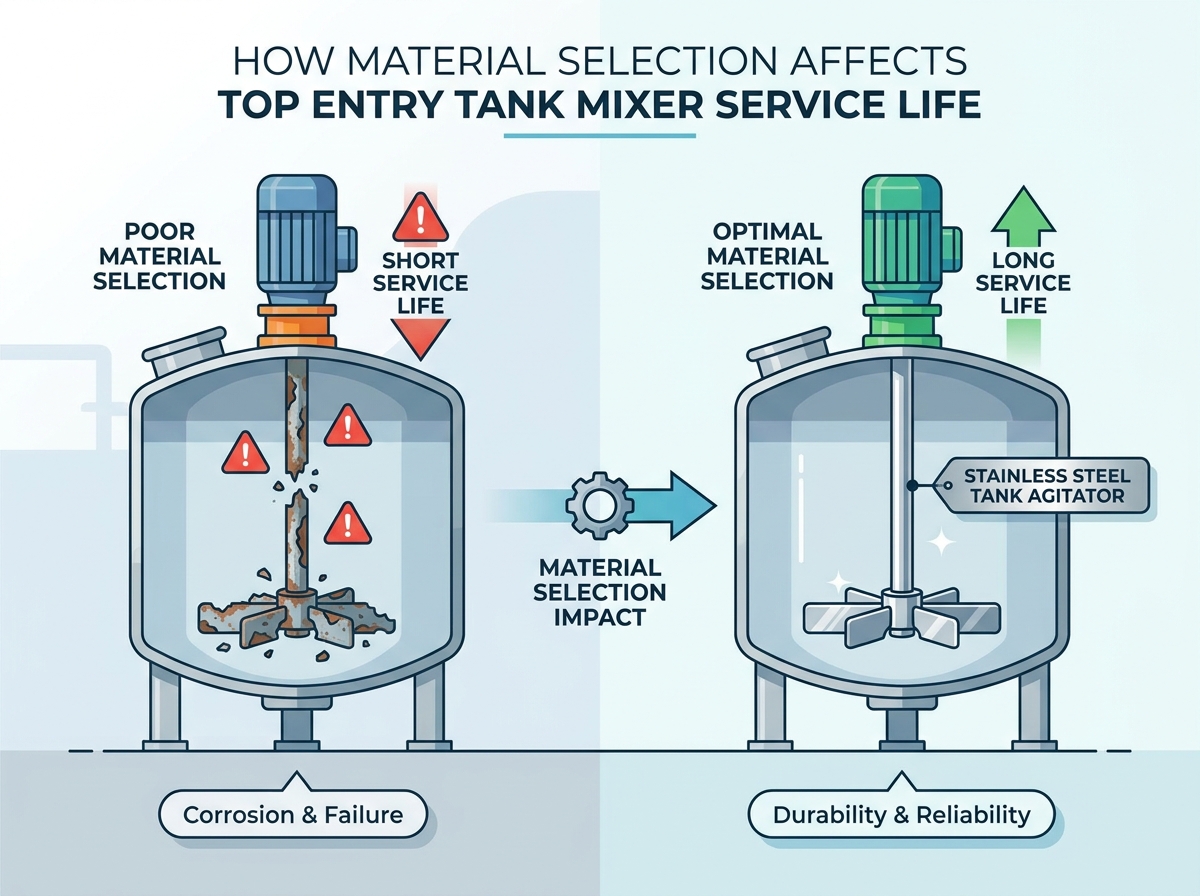
Premature mixer failure in industrial processing carries compounding penalties that extend far beyond the initial capital expenditure. Unscheduled downtime halts production lines entirely. Batch contamination ruins thousands of gallons of valuable product. Replacement labor consumes your maintenance resources for days. These failures rarely stem from manufacturing defects at the factory. Instead, they originate from a fundamental misalignment between fluid properties—such as corrosivity, abrasiveness, and viscosity—and the specified wetted materials of the mixer. When materials cannot withstand the process environment, operations experience accelerated wear, severe shaft deflection, or catastrophic mechanical failure. Specifying the correct material is the primary lever for extending equipment service life and ensuring regulatory compliance in top entry configurations. Upgrading from standard alloys to a high-grade stainless steel tank agitator stabilizes long-term operational reliability. Proper material selection prevents degradation, maintains structural integrity under heavy loads, and keeps production running without unexpected interruptions.
Material incompatibility is the leading cause of premature failure in wetted mixing components; matching alloy grades to chemical and abrasive profiles is non-negotiable for long-term reliability.
A stainless steel tank agitator (specifically 316/316L) serves as the industrial baseline for corrosion resistance, but high-chloride, extreme-pH, or high-temperature environments require specialized alloys, coatings, or advanced surface treatments.
Mechanical stress and bending moments are heavily influenced by tank geometry and baffling; improper tank configurations accelerate mechanical wear regardless of alloy grade.
Regulatory standards (FDA, ASME BPE, 3-A) and precise surface finishes (electropolishing, low Ra values) are as critical to service life and corrosion prevention as the bulk metal chemistry itself.
Top entry mixers inherently reduce seal wear and fluid leakage risks compared to side entry alternatives, but they require precise shaft material specification to handle high bending moments.
Evaluating total cost of ownership requires factoring in energy efficiency, bearing life, and maintenance intervals alongside the upfront cost of premium materials.
Success in industrial mixing relies on quantifiable service life metrics. We measure this through Mean Time Between Failures (MTBF), continuous operation hours, and extended maintenance intervals. Achieving high marks in these areas requires understanding exactly how wear mechanisms attack mixing equipment in the field. You cannot simply install a mixer and expect it to run indefinitely without accounting for the specific physical and chemical forces acting upon the wetted parts.
Corrosive fluids actively degrade the passive oxide layer of standard metals. This chemical attack leads to localized pitting, stress corrosion cracking (SCC), and crevice corrosion on shafts and impellers. Once the passive layer breaches, the underlying metal deteriorates rapidly. In facilities handling aggressive acids or high-chloride solutions, a standard metal shaft can lose significant structural integrity within months. Pitting creates stress concentrators, which eventually lead to fatigue failure under the rotational load of the mixer.
Mechanical wear presents a completely different physical challenge. Solid particle suspension and high-shear applications physically strip material from the impeller blades over time. Abrasive slurries act like liquid sandpaper against rotating components. When you mix mining slurries, ceramic slips, or crystalized chemical compounds, the leading edges of the impeller blades take a massive beating. Over time, the blades lose their engineered profile, which drastically reduces mixing efficiency and increases the load on the motor.
Erosion-corrosion creates a severe synergistic effect that destroys equipment faster than either mechanism alone. Mechanical abrasion continuously removes the protective oxide layers formed by the metal. This exposes fresh, unprotected metal to chemical attack. The chemical attack softens the surface, making it even more susceptible to mechanical abrasion. This cycle accelerates the overall degradation rate far beyond what standard corrosion tables predict.
Wear Mechanism | Primary Cause | Physical Symptom | Field Mitigation Strategy |
|---|---|---|---|
Pitting Corrosion | High chloride concentration | Deep, localized holes in metal | Upgrade to high-molybdenum alloys |
Abrasive Wear | High solid particulate loading | Loss of impeller blade thickness | Apply tungsten carbide hard-facing |
Crevice Corrosion | Stagnant fluid under fasteners | Deterioration at bolted joints | Use welded impeller construction |
Erosion-Corrosion | High velocity acidic slurries | Rapid, smooth material loss | Reduce RPM, increase blade surface area |
Blending highly viscous fluids drastically increases torque requirements. Thick materials resist flow, inducing severe torsional stress on the agitator shaft. The drive system must push harder, transferring that energy down the shaft to the impellers. When viscosity changes during a batch process—such as in polymer reactions or food blending—the mixer experiences dynamic loading. The shaft must handle these fluctuating forces without yielding.
Material yield strength becomes critical in these high-viscosity applications. In deep tank mixing scenarios, the shaft must resist deflection. If the metal lacks sufficient rigidity, the shaft bends under the fluid resistance. This deflection causes severe vibration, damages mechanical seals at the mounting flange, and destroys gear reducer bearings. A shaft that deflects more than a fraction of an inch at the seal will cause immediate leakage and premature bearing failure.
Tank shape directly dictates fluid flow patterns and the resulting forces on the mixer. Flat-bottom tanks often cause solid particle accumulation, creating wear-prone dead zones in the corners. Dished or conical bottoms promote better fluid turnover and keep solids suspended, reducing localized abrasion on the lower impellers. The geometry of the vessel determines how hard the mixer has to work to achieve homogeneity.
Unbaffled tanks induce fluid swirling and vortexing. This rotational flow creates high unbalanced radial loads. These forces push laterally against the shaft, causing severe deflection and metal fatigue. Operating a top entry mixer in an unbaffled tank without accounting for these radial loads is a guaranteed path to broken shafts and shattered gearboxes.
Installing wall baffles converts radial forces into axial mixing flow. While this improves mixing efficiency and stops the vortex, it increases the mechanical stress profile on the impeller blades and the top-entry mounting structure. The fluid hits the baffles and pushes back against the rotation. The materials must absorb this increased resistance without bending or cracking.
Restarting an agitator after solids have settled out of suspension generates massive mechanical shock. The impellers must break through compacted solids at the bottom of the tank. This creates extreme torque spikes that can shear standard shafts or fracture impeller blades instantly. Operators must use variable frequency drives to slowly ramp up speed, or the mechanical components will fail under the sudden load.
Selecting the right material grade defines the operational limits of your mixing equipment. Different environments demand specific metallurgical properties to survive continuous exposure. You cannot guess when it comes to metallurgy; you must match the alloy to the chemical profile of the process fluid.
Standard 304 stainless steel offers basic corrosion resistance. It works well for standard food-grade applications, municipal water treatment, and low-corrosion environments. It contains chromium and nickel, which form a basic passive layer. However, it struggles heavily in the presence of chlorides. Even mild salt solutions will cause 304 to pit and rust over time.
Upgrading to 316 or 316L introduces molybdenum into the alloy matrix. This specific addition significantly boosts resistance to chlorides and localized pitting. The "L" designates a lower carbon content. This lower carbon level prevents carbide precipitation during welding, maintaining corrosion resistance at the weld seams. If you weld a standard 316 shaft, the heat-affected zone becomes vulnerable to corrosion. 316L solves this problem entirely.
You should justify the premium for 316L when processing pharmaceuticals, handling aggressive chemicals, or operating in mild saline environments. The extended lifespan easily offsets the initial material upgrade. In most industrial facilities, 316L has become the default standard because the labor cost of replacing a failed 304 shaft far exceeds the price difference of the raw material.
Surface roughness, measured in Ra (Roughness Average), directly impacts sanitize-ability and corrosion resistance. Smoother, polished surfaces leave no microscopic pits for microbial buildup or micro-crevice corrosion to take hold. A standard mill finish might have an Ra of 150 microinches, which looks smooth to the naked eye but resembles a mountain range under a microscope. Bacteria and corrosive chemicals hide in those microscopic valleys.
Chemical passivation and electropolishing maximize the chromium-oxide passive layer. Passivation uses nitric or citric acid to remove free iron from the surface. Electropolishing takes this a step further. It uses an electrical current and an acid bath to actually melt away the microscopic peaks of the metal. This removes surface impurities and creates a highly uniform, ultra-smooth, corrosion-resistant barrier essential for aggressive environments.
Governing standards dictate these material processing requirements strictly. ASME BPE governs bioprocesses, FDA regulates food contact, and 3-A Sanitary Standards ensure dairy compliance. Meeting these standards requires specific polishing and passivation protocols. You cannot simply use a grinder to smooth a weld; you must follow certified mechanical and chemical polishing procedures to achieve the required Ra values.
A standard stainless steel tank agitator will fail under extreme conditions. Extreme mineral acids like hydrochloric or sulfuric acid, high-temperature halogens, and wet chlorine rapidly destroy even the best 316L stainless steel. In these environments, the passive layer dissolves instantly, and the metal vanishes into the solution.
High-performance alloys step in where stainless fails. Hastelloy (specifically C-276 and C-22) handles severe chemical processing and mixed acid environments. Titanium excels in wet chlorine and bleach applications. Duplex stainless steels (like LDX 2101 or Duplex 2205) offer twice the yield strength of 316L and excellent chloride stress corrosion cracking resistance. Duplex is often used for very long shafts where both strength and corrosion resistance are mandatory.
PTFE, PVDF, or rubber-lined wetted parts provide cost-saving alternatives to solid exotic alloys. Instead of buying a solid Hastelloy shaft, you coat a carbon steel shaft in PTFE. However, these coatings carry significant operational risks. They exhibit mechanical fragility. High-shear conditions, accidental tool drops during maintenance, or abrasive particles can cause coating delamination. Once the coating breaches, the aggressive fluid instantly attacks the vulnerable carbon steel base metal, leading to rapid and catastrophic failure.
Material Grade | Primary Application | Corrosion Resistance | Abrasion Resistance |
|---|---|---|---|
304 Stainless Steel | Standard food & beverage, water | Moderate (Poor against chlorides) | Moderate |
316/316L Stainless Steel | Pharmaceuticals, mild chemicals | High (Good chloride resistance) | Moderate |
Duplex 2205 | High-stress, saline environments | Very High | High |
Hastelloy C-276 | Extreme acids, harsh chemicals | Extreme | Moderate |
PTFE Coated | Highly corrosive, low-shear | Extreme (Chemical barrier) | Low (Prone to delamination) |
The physical orientation of the mixer dictates material fatigue and long-term wear patterns. Understanding these conceptual trade-offs ensures proper specification for your specific tank layout. You must evaluate how gravity, fluid pressure, and shaft length interact with your chosen materials.
Top entry mixers require longer shafts to reach the fluid from the top of the tank. This length increases the bending moment significantly. The shaft acts as a giant lever, multiplying the hydraulic forces acting on the impellers at the bottom. This necessitates materials with high tensile strength and extreme rigidity to prevent deflection. If you use a weak material for a long shaft, it will whip and vibrate violently during operation.
Side entry mixers push fluid horizontally across the bottom of the tank. While they use much shorter shafts, they expose mechanical seals directly to the hydrostatic pressure of the tank contents. Abrasive contents constantly grind against these submerged seals. If the tank holds a sandy slurry, that sand sits directly on the seal faces, leading to frequent leaks, rapid seal face wear, and messy maintenance procedures that require draining the entire tank.
Operational realities heavily favor top entry designs for long-term reliability. Side entry mixers often require three to five times more mixing energy to achieve the same turnover or suspend heavy solids. They fight against the natural settling of gravity, trying to push solids across the floor rather than lifting them up into suspension.
Lower energy requirements in top entry mixers correlate directly with reduced mechanical strain. Less energy means less stress on gear reducers, motor bearings, and mounting flanges. This reduction in continuous mechanical strain significantly extends the overall service life of the drive components. When the motor and gearbox work less, they run cooler and last longer.
Mapping specific materials to individual mixer components demonstrates a holistic approach to specification. Every part must survive its specific operating environment. You cannot focus solely on the shaft and ignore the impellers or the seals.
Impeller type interacts heavily with material selection and wear rates. Axial flow, radial flow, and hydrofoil designs handle fluid differently. Proper selection maintains uniform suspension and eliminates bottom dead zones. The material must handle the specific solid suspension without rapid blade degradation. A high-efficiency hydrofoil moves a lot of fluid with low shear, but its thin blades are highly susceptible to abrasive wear.
Severe abrasive slurries destroy standard blades quickly. Applying hard-facing or tungsten carbide coatings on the impeller leading edges dramatically extends lifespan. These coatings take the brunt of the abrasive impact, protecting the base metal underneath. In mining applications, a standard 316L blade might last three months, while a tungsten-carbide coated blade can last over two years in the exact same slurry.
Impeller Type | Flow Pattern | Shear Level | Best For |
|---|---|---|---|
Marine Propeller | Axial | Medium | Small batch blending, low viscosity |
Pitched Blade Turbine | Axial / Radial | High | Heavy solid suspension, viscous fluids |
Rushton Turbine | Radial | Very High | Gas dispersion, intense mixing |
Hydrofoil | Axial | Low | High flow, low energy blending |
Heavy-duty, impeller shaft support bearings are an absolute necessity for top entry units. They handle the intense radial loads generated during mixing. Without robust bearings, shaft deflection transfers directly into the gearbox, destroying the internal gears. The bearings act as the structural firewall between the turbulent fluid forces and the precision drive mechanics.
Sealed-for-life helical gear reducers offer excellent protection against environmental contamination in clean facilities. However, maintainable systems often perform better in demanding, heavy industrial environments. In a chemical plant, routine oil analysis and scheduled bearing replacement prevent catastrophic drive failures. You need the ability to drain the oil, check for metal shavings, and replace seals without sending the entire unit back to the manufacturer.
Seal selection depends entirely on tank pressure and chemical compatibility. Lip seals work for basic dust and vapor control in atmospheric tanks. Mechanical seals, either single or double, are required for pressurized tanks, vacuum applications, or hazardous vapors. The seal faces (often silicon carbide or tungsten carbide) and the elastomers (Viton, EPDM, Kalrez) must be chemically compatible with the mixed product to prevent rapid degradation and hazardous leaks.
Even the best-specified materials fail if implementation and operation are flawed. Avoiding common pitfalls ensures the equipment reaches its designed lifespan. You must install and operate the equipment according to strict engineering guidelines.
Operating an agitator near its critical speed causes severe harmonic vibration. Every shaft has a natural frequency. If the rotational speed matches this frequency, resonance occurs. This resonance can cause catastrophic shaft failure in minutes, regardless of material strength. The shaft literally shakes itself apart, bending violently until it snaps or tears the mounting flange off the tank.
Mitigation requires precise engineering during the design phase. Use variable frequency drives (VFDs) to ramp through critical speeds quickly during startup. Ensure proper shaft sizing (increasing the diameter) to push the critical speed well above the maximum operating range. Install stabilizing rings on the bottom impellers for long, overhung shafts to dampen lateral movement.
A preventative maintenance framework protects wetted components and prevents unexpected downtime. Focus on early detection. Inspect the tank interior regularly for localized pitting on the shaft, blade erosion on the impellers, and weld decay at the joints. Implement bearing vibration analysis on the drive system to catch wear before it transfers damaging harmonic stress down the shaft. Take regular oil samples from the gearbox to monitor for internal gear wear.
Extending the service life of a top entry mixer begins with matching every wetted component to the actual process environment. Fluid chemistry, chloride concentration, temperature, viscosity, solid loading, and abrasion level all influence whether 304 stainless steel, 316L, duplex steel, an exotic alloy, or a protective coating is appropriate.
Material grade alone, however, cannot prevent every failure. Tank geometry, baffling, shaft length, impeller design, startup conditions, and critical-speed limits determine the mechanical stresses placed on the shaft, bearings, seals, and gearbox. Surface finishing, passivation, weld quality, and sanitary requirements also affect corrosion resistance and cleanability.
The most reliable agitator is therefore not automatically the one made from the most expensive alloy. It is the system whose material, mechanical design, operating controls, and maintenance plan work together under real process conditions.
A: Service life typically spans 10 to 20 years under proper conditions. This lifespan depends heavily on continuous versus batch operation, fluid abrasiveness, chemical compatibility, and strict adherence to routine maintenance schedules like oil changes and seal inspections.
A: Top entry mixers offer lower energy consumption, better solid suspension, and eliminate submerged mechanical seals. This orientation keeps critical sealing components out of the abrasive fluid, drastically reducing maintenance frequency and the risk of catastrophic tank leaks.
A: Use 304 stainless steel for basic municipal water treatment, mild food and beverage processing, and environments completely free of chlorides or harsh corrosive chemicals. It is a cost-effective choice for non-aggressive fluids.
A: High viscosity increases fluid resistance, demanding higher torque from the motor. This induces severe torsional stress and increases the bending moment on the shaft, requiring thicker, higher-strength materials to prevent deflection and vibration.
A: Shaft failure usually results from operating at critical speeds, severe unbalanced radial loads from unbaffled tanks, or sudden torque spikes from restarting the mixer while impellers are buried in settled solids.
A: Coatings like PTFE offer excellent chemical resistance at a lower initial cost. However, they are mechanically fragile. Solid alloys are vastly superior for high-shear or abrasive applications where coatings would quickly scratch and delaminate.