- All
- Product Name
- Product Keyword
- Product Model
- Product Summary
- Product Description
- Multi Field Search
Please Choose Your Language
Views: 0 Author: Site Editor Publish Time: 2026-11-25 Origin: Site
Forcing an agitator to turn in cooled, high-viscosity bitumen guarantees catastrophic equipment failure. You risk sheared shafts, destroyed gearboxes, burnt-out motors, and compromised mix quality. Asphalt undergoes exponential viscosity increases as temperatures drop. Operators frequently misjudge the internal core temperature of the tank based solely on perimeter sensor readings. This miscalculation leads to premature restarts that destroy mechanical components. It also triggers dangerous moisture boil-overs and halts plant production entirely. A safe asphalt tank mixer startup requires a rigid, evidence-based protocol. You must combine thermal soaking verification with mechanical breakaway torque management. Strict safety procedures and modern motor control evaluations are necessary to mitigate implementation risks. This guide details the exact steps to restart your system safely after a cooling period, ensuring you protect your machinery and maintain binder integrity.
Perimeter temperature gauges do not accurately reflect the core viscosity of a cooled asphalt tank; mandatory "thermal soak" times must be calculated and observed to prevent equipment failure and bitumen degradation.
An asphalt mixer low temperature startup requires specialized motor controls—such as Variable Frequency Drives (VFDs) or soft starters—to monitor and limit breakaway torque.
Manual mechanical checks (e.g., Lockout/Tagout verified manual shaft rotation and the "bump" test) remain a non-negotiable step before engaging automated continuous mixing.
Pre-startup maintenance, including verifying temperature controller actuators and ensuring proper gearbox lubrication, drastically reduces secondary mechanical drag.
Evaluating and upgrading agitator blade profiles and heating coil distribution can permanently reduce the risk of cold-start equipment failure.
Understanding the physical state of cooled asphalt is your first operational priority. Success means achieving a uniform viscosity throughout the tank. This fluidity allows the agitator to rotate without exceeding the motor's Service Factor (SF). You must achieve this mechanical freedom while maintaining the chemical integrity of the bitumen.
Cooling bitumen exhibits severe non-Newtonian behavior. Shear stress requirements spike drastically when the material drops below its optimal pumping threshold. Polymer-modified asphalts (PMAs) containing Styrene-Butadiene-Styrene (SBS) or Ethylene-Vinyl Acetate (EVA) harden even faster than neat bitumen. These polymers form a cross-linked matrix as they cool. This creates a rubbery, highly resistant core that demands massive shear force to break. The "cold core" phenomenon occurs frequently in large storage vessels. Material near the heating coils becomes fluid quickly due to direct conduction. However, the center mass around the agitator shaft relies on slow thermal convection. This central mass remains semi-solid for hours or even days after the perimeter reaches the target temperature.
Cooling tanks also draw in moist ambient air. This creates significant condensation inside the vessel roof and walls. Starting the agitator before safely evaporating this moisture causes severe foaming. You risk violent boil-overs that endanger personnel and coat equipment in hot asphalt. A failed asphalt mixer low temperature startup often stems from ignoring these thermal and moisture dynamics. Operators assume a hot perimeter means a hot core, leading to disastrous mechanical engagement.
The duration of the cooling period directly dictates your required thermal recovery time. A tank offline for a weekend requires a different approach than a tank offline for a month. Longer cooling periods require exponentially longer reheating phases to penetrate the dense core.
When you force a start in viscous material, you expose specific mechanical failure points:
Gearbox shear pins snap immediately under sudden, unyielding loads.
Motor windings burn out rapidly from excessive, sustained amp draw.
Agitator shaft couplings twist, deform, or shear completely.
Impeller blades bend out of alignment, ruining future mixing efficiency.
Cold, highly viscous gear oil in the agitator drive system compounds the problem. It adds secondary mechanical drag before the shaft even tries to move the asphalt. This internal friction significantly increases the total breakaway torque required to initiate movement.
You must move beyond traditional temperature monitoring. Comprehensive thermal profiling and active hardware checks ensure the tank is truly ready for agitation. Relying on a single digital readout invites mechanical failure.
Standard Resistance Temperature Detectors (RTDs) mounted on the tank shell have severe limitations. They only read the temperature of the fluid immediately adjacent to the heated walls. They cannot measure the cold core surrounding the central shaft. A perimeter reading of 300°F (149°C) often masks a core temperature of 150°F (65°C). Plant operators should utilize infrared thermography on the tank exterior. Scanning the tank shell with an IR camera reveals cold zones and insulation voids. This provides a visual map of internal heat distribution.
You must calculate thermal penetration based on several physical factors:
Total tank volume and internal geometry.
Quality, thickness, and condition of exterior insulation.
Total BTU capacity of the thermal heating system.
Ambient weather conditions during the reheating phase.
Thermal fluid heaters and electric dry-well heaters perform differently during reheating. Thermal oil systems provide broad, even heat distribution across extensive coil networks. Electric heaters offer rapid, localized heating. However, electric systems risk scorching the bitumen if the material is not circulated promptly.
You must physically verify temperature controller actuators and thermal oil valves. Walk out to the tank and watch them. Ensure they achieve a full mechanical stroke. Confirm they actively deliver heat to the coils. A stuck valve will show a false readiness state on the control panel. The computer thinks the tank is heating, but the coils remain cold.
Define a strict "soak time" in your operating procedures. After reaching the target setpoint, hold the temperature before attempting mechanical movement. Rapid, localized overheating degrades mix quality and damages the binder. Allow the heat to radiate inward to melt the core completely.
You must assess how different mechanical and electrical systems handle immense rotational resistance during a cold restart. Managing this force is the difference between a smooth startup and a destroyed gearbox.
Baseline operating torque applies when the bitumen is in a fully fluid, heated state. The motor draws normal running amps. Breakaway torque is the massive initial force required to initiate movement in a cooled, viscous tank. This force can be three to five times higher than baseline running torque. You must understand the motor's torque curve. Starting torque is the maximum force the motor generates at zero RPM. If the resistance of the cold asphalt exceeds this value, the motor stalls. The electrical energy converts entirely to heat, melting the winding insulation within seconds.
Calculating maximum allowable asphalt storage agitator torque prevents mechanical yield. You must compare the motor's locked-rotor torque against the gearbox's maximum torque rating. Exceeding this limit guarantees component failure. The weakest link in the drive train will always break first.
VFDs provide controlled, low-frequency starts. They use flux vector control to deliver high torque at very low speeds. This prevents sudden mechanical shock to the shaft and impellers. Across-the-line starters slam the equipment with 100% force instantly, which is disastrous in cold asphalt.
Program strict current (amp) limits into the VFD. Set torque-proving parameters to fault out safely if resistance remains too high. For example, program the drive to trip if amps exceed 110% of Full Load Amps (FLA) for more than three seconds. This prevents the motor from tearing the shaft apart.
Physical fail-safes remain absolutely necessary. Instantaneous electronic shear pins or mechanical shear couplings protect the heavy drive train. Relying solely on standard thermal overload relays is dangerous. They often react too slowly to prevent shaft twisting during a violent cold start.
Prioritize pre-start lubrication. Grease all external bearings thoroughly. Verify gearbox oil heaters are active if your unit is equipped with them. Warm gear oil minimizes internal friction before startup. Using synthetic gear lubricants also improves cold-weather flow characteristics, reducing secondary drag on the motor.
Provide a rigid operational framework for your plant crew. Eliminate operator guesswork, ensure personnel safety, and prevent equipment damage. Follow these phases strictly.
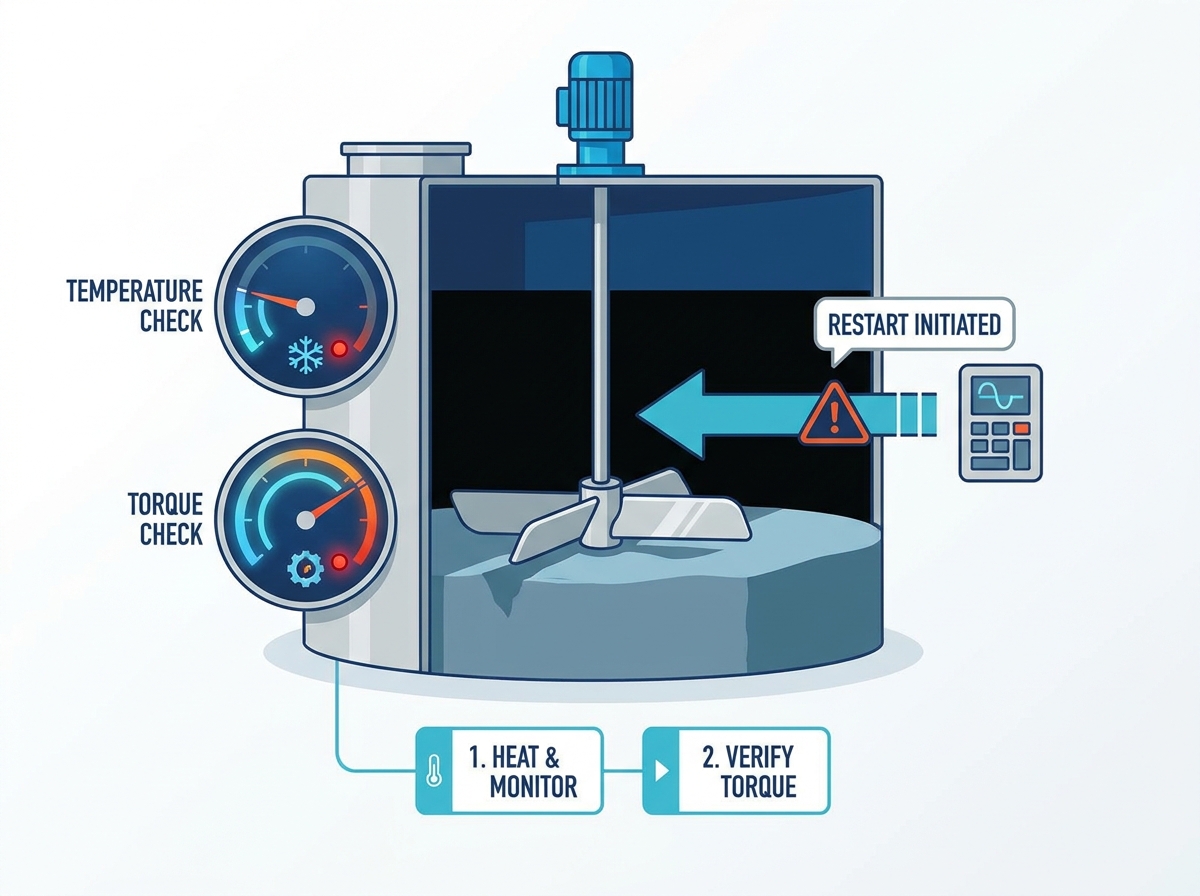
Verify heating system operation step-by-step. Confirm the setpoint on the main controller. Walk to the tank and watch the actuator physically engage. Ensure hot oil flows freely to the internal coils.
Enforce a mandatory hold period. This soak time often lasts 12 to 24 hours, depending on the cooling duration and tank size. Ensure all tank vents remain clear and unobstructed. You must safely release boiled-off condensation to prevent internal pressure buildup and foaming.
Execute strict Lockout/Tagout (LOTO) procedures. Secure the main power supply before any personnel approach the drive assembly. Never bypass safety protocols to save time.
Manually turn the motor cooling fan or input shaft by hand. This verifies basic freedom of movement. If you cannot turn the shaft by hand with moderate effort, the motor will fail to turn it. Do not proceed if the shaft is locked solid.
Execute the "bump" test using this exact sequence:
Clear all personnel from the immediate vicinity of the tank roof and drive assembly.
Remove the LOTO devices from the main motor disconnect.
Station one operator at the motor control panel and one observer near the gearbox at a safe distance.
Engage the motor contactor for exactly one to two seconds, then immediately disengage.
The observer must watch the motor coupling and input shaft for movement.
Listen closely for abnormal groaning, popping, or metallic grinding from the gearbox.
If the shaft does not move, or if the gearbox emits severe strain noises, the test has failed. Do not commit to continuous rotation. This is a critical validation phase of a bitumen tank agitator restart. Return to Phase 1 and increase the thermal soak time by at least four hours.
Use the VFD to slowly ramp up agitator speed. Start at 10 Hz and monitor the amp draw continuously on the display. Keep the speed low until the tank achieves full thermal equilibrium. Gradually increase RPMs over several hours as the mix quality becomes homogenized and viscosity drops.
Guide your decision-makers on retrofitting existing tanks versus investing in new mixing technology. Prevent future downtime through smart, targeted mechanical upgrades.
Compare low-shear, high-flow impeller designs against traditional flat paddles. High-flow axial impellers handle high-viscosity startups much better. They slice through thick material with significantly less resistance. They promote fluid movement without acting like a solid wall.
Evaluate the trade-off between mixing efficiency and cold-start resistance. Paddle mixers homogenize well in hot fluid but present massive surface area. This large surface area exponentially increases breakaway torque requirements when the asphalt cools.
Assess the return on investment of replacing outdated across-the-line starters. Intelligent MCCs provide real-time torque monitoring. They offer automated fault logging to diagnose startup issues instantly. Integrating smart MCCs with your plant SCADA system allows remote monitoring of amp draw during the critical reheat phase. You can also integrate PLC interlocks that physically prevent the motor contactor from closing unless the temperature has been at setpoint for a predetermined number of hours.
Calculate the true cost of a catastrophic agitator failure. Include replacement parts, emergency crane labor, lost production days, and ruined bitumen. Compare this massive expense against the upfront cost of VFDs, better heating coils, and automated lubrication systems.
Equipment Type | Cold Start Risk Level | Primary Advantage | Recommended Application |
|---|---|---|---|
Across-the-Line Starter | High | Low initial installation cost | Small tanks, continuous high temperatures |
VFD Control | Low | Controlled torque limits and soft starts | Large storage, frequent cooling cycles |
Traditional Paddle Blades | High | Aggressive blending in fluid states | Fully fluid, low-viscosity mixing |
Low-Shear Impellers | Low | Reduced breakaway resistance | High-viscosity, cold-start environments |
Gearbox Oil Heaters | Low | Eliminates secondary mechanical drag | Cold climates, outdoor exposed tanks |
Upgrading your drive systems and impellers provides long-term operational stability. It removes the human error element from cold-weather restarts.
An asphalt tank mixer startup after cooling is never as simple as flipping a switch. It requires a calculated process of thermal management, mechanical verification, and strict torque limitation. Audit your current tanks immediately. If a tank lacks VFD control, relies on a single perimeter sensor, or has unverified actuators, it demands an immediate operational upgrade.
Take these actionable next steps to secure your plant operations:
Schedule a comprehensive technical audit of all tank heating systems, valves, and exterior insulation.
Update standard operating procedures to mandate LOTO and manual bump tests for every cold restart.
Consult an industrial mixing engineer to evaluate VFD retrofits for your highest-risk storage tanks.
Implement a mandatory 12-hour minimum thermal soak rule for any tank that drops below pumping temperature.
A: It depends on the specific PG grade of the bitumen. Generally, it requires reaching the manufacturer's specified pumping temperature. You must hold it for a thermal soak period to ensure core fluidity before starting the mixer.
A: High viscosity in the cooled asphalt causes the breakaway torque to spike. This exceeds the motor's locked-rotor amp capacity. Thermal overloads or breakers trigger automatically to prevent electrical fires and motor burnout.
A: Reheating time varies by tank size, insulation, and heating capacity. A standard rule dictates a 12 to 24-hour thermal soak after the perimeter sensors reach the target temperature. This ensures the cold core melts completely.
A: A temperature controller may show a demand for heat. However, if the thermal oil valve or electric actuator is stuck closed, the tank will not reheat properly. This creates a false sense of readiness and causes a catastrophic cold start.
A: Tanks draw in moisture as they cool. If the agitator starts before this moisture safely boils off during reheating, it causes rapid foaming. This leads to dangerous boil-overs that threaten personnel and equipment.
A: Yes. A properly programmed VFD limits the maximum current and torque applied to the shaft. It faults out safely before the mechanical yield strength of the shaft or gearbox is exceeded.